← Home · Laboratory

Laboratory CBR Testing in Sarnia: NBCC & ASTM-Compliant Subgrade Design

Together, we solve the challenges of tomorrow.

LEARN MORE →

The National Building Code of Canada references ASTM D1883 as the benchmark for California Bearing Ratio determination, and in Sarnia—where shallow groundwater and clay-rich tills dominate—this test is not optional. We run the laboratory CBR on both undisturbed Shelby tube samples and remolded specimens compacted to Proctor density, measuring penetration resistance at 0.1-inch intervals with a calibrated loading frame. Sarnia sits on the St. Clair Plain, a glaciolacustrine deposit where moisture sensitivity can drop subgrade modulus by 40% between dry and soaked states. Before locking in a pavement cross-section, we recommend pairing the CBR with a grain size analysis to confirm fines content, because silty clays with PI above 20 respond poorly to saturation and skew the CBR value downward. Our laboratory in Southwestern Ontario processes over 200 CBR samples annually for road widenings, industrial yards, and commercial pads across the Sarnia-Lambton corridor.

A soaked CBR of 3 or less in Sarnia's glaciolacustrine clays means the subgrade cannot support construction traffic without a stabilization plan.

Process and scope

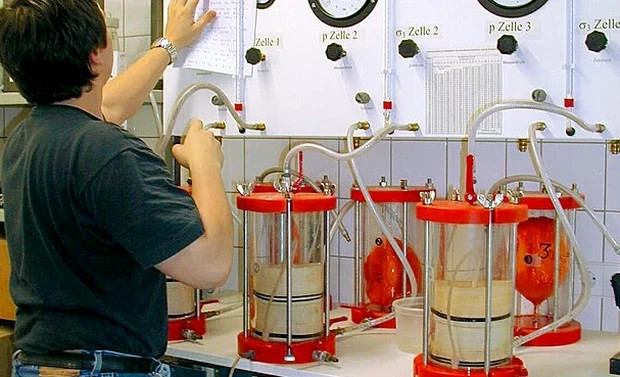
A common mistake we see in Sarnia is contractors accepting CBR values from air-dried samples without running the mandatory 96-hour soak. The difference is dramatic: a sample compacted at optimum moisture may read CBR 18 dry but collapse to CBR 4 or 5 after soaking, which pushes the design from a thin flexible pavement straight into a thick granular base with geogrid reinforcement. We run the full procedure—soaking under a 4.5 kg surcharge, swelling measurement every 24 hours, then penetration at 1.27 mm/min—and report both the unsoaked and soaked curves on the same graph. When the CBR falls below 3, the subgrade typically requires stabilization with lime or cement, and we often cross-reference results with Atterberg limits to quantify the plasticity index driving the low strength. For clients designing rigid pavements over poor ground, the soaked CBR feeds directly into the modulus of subgrade reaction used in rigid pavement thickness calculations. We also correlate CBR with CPT test data when site access allows, building a continuous strength profile that reduces the number of laboratory specimens needed.
Laboratory CBR Testing in Sarnia: NBCC & ASTM-Compliant Subgrade Design
Technical reference image — Sarnia

Local ground factors

Sarnia's proximity to Lake Huron and the St. Clair River creates a groundwater regime that fluctuates seasonally by 1.5 to 2.5 metres, and this directly impacts the relevance of a laboratory CBR. A sample soaked for 96 hours under surcharge simulates long-term saturation, but if the design groundwater table is misjudged—say, the investigation was drilled in August during seasonal lows—the in-service moisture content may exceed the soaked test condition, producing CBR values even lower than the lab predicted. We have seen parking lots in Sarnia develop alligator cracking within three years because the pavement design used CBR from samples taken above the spring water table, ignoring the capillary fringe that saturates the upper subgrade from March through May. For sites within 800 metres of the river, we recommend running the CBR on specimens conditioned to 2% above optimum moisture content to bracket the worst-case scenario. The cost of an extra CBR point is negligible compared to the cost of excavating failed subgrade under an occupied parking lot.
Need a geotechnical assessment?

Reply within 24h.

Email: [email protected]

Technical parameters

ParameterTypical value
Standard referenceASTM D1883-21
Sample preparationStandard / Modified Proctor (ASTM D698 / D1557)
Soaking period96 hours under 4.5 kg surcharge
Penetration rate1.27 mm/min (0.05 in/min)
Typical Sarnia clay CBR (soaked)2–6 (high-plasticity till)
Typical Sarnia granular CBR15–45 (OPSS Granular B)
Swelling potential range0.5–4.0% of initial height
Reported valuesCBR at 2.54 mm & 5.08 mm penetration

Associated technical services

01

Soaked & Unsoaked CBR

Full ASTM D1883 procedure on undisturbed and remolded specimens, including 96-hour soak with swell monitoring and load-penetration curves to 10.0 mm.

02

CBR vs. Moisture-Density Relationship

Three-point compaction curve with CBR determined at each moisture content, identifying the sensitivity envelope that drives pavement design robustness.

03

Subgrade Modulus Correlation

Conversion of soaked CBR to resilient modulus (Mr) using NCHRP 1-37A and MEPDG correlations for input into AASHTOWare Pavement ME Design.

04

Stabilization Verification Testing

CBR before and after lime, cement, or fly-ash treatment to quantify strength gain and confirm that the stabilized layer meets the target design CBR of 20 or higher.

Applicable standards

ASTM D1883-21 — Standard Test Method for California Bearing Ratio (CBR) of Laboratory-Compacted Soils, OPSS 1010 — Material Specification for Aggregates (Ontario Provincial Standard), CSA A23.1 / A23.2 — Concrete Materials and Methods of Concrete Construction / Test Methods, NBCC 2015 — National Building Code of Canada (geotechnical references), MTO Laboratory Testing Manual LS-700 — CBR test procedure

Quick answers

How much does a laboratory CBR test cost in Sarnia?

A single-point CBR test including compaction and 96-hour soak typically ranges from CA$170 to CA$280, depending on whether the sample is undisturbed Shelby tube or remolded bulk material. A full moisture-density-CBR curve with three points runs higher due to the additional compaction and testing effort.

What is the minimum soaked CBR required for a flexible pavement in Sarnia?

The Ontario MTO and City of Sarnia standards generally require a minimum soaked CBR of 6 for residential streets and 10 or higher for arterial roads. Values below 3 mandate subgrade stabilization or a thickened granular base with geotextile separation; values below 1 are considered unsuitable for pavement without deep reconstruction.

Can you run a CBR on a sample that has already been used for Atterberg limits?

No—the CBR test requires a specimen compacted at a specific moisture content and density, so the material must be fresh or carefully reconditioned. We prefer to cast the CBR specimen first from the bulk sample and then use the trimmings for index testing such as grain size and Atterberg limits, which keeps the chain of custody clean and avoids drying-induced changes to the clay fraction.

Location and service area

We serve projects in Sarnia and surrounding areas.

View larger map