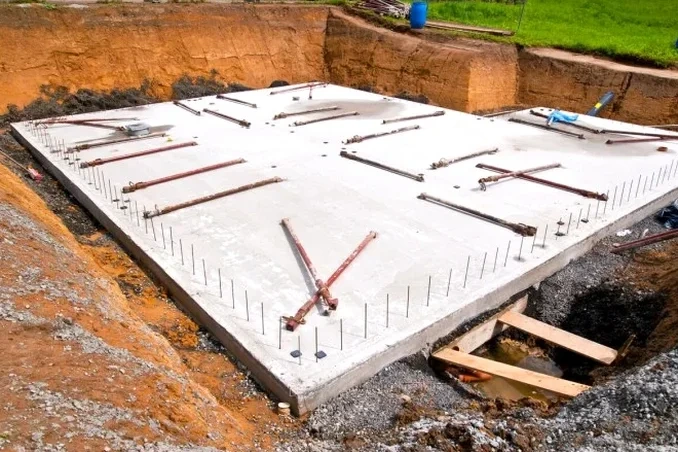
The clay belt underlying Sarnia presents a unique challenge for structural engineers. The local soil is highly susceptible to seasonal volume changes, shifting dramatically between the saturated spring thaw and the arid late-summer drought. This movement generates differential heave that can crack a conventional footing system within a few years. A rigid raft foundation, designed with accurate geotechnical input, floats the entire structure over these active clays. Our laboratory provides the precise soil parameters needed to model slab stiffness and reinforcement, moving beyond generic assumptions to a site-specific solution for the Chemical Valley region.
In Sarnia, a properly designed raft isn't just a slab—it's a stiffened boat floating on an ocean of reactive clay.
Quick answers
When is a raft foundation necessary instead of isolated footings in Sarnia?
When the site investigation reveals high-plasticity clays with a potential for differential heave exceeding tolerable limits for the structure. In Sarnia, this is common when the clay extends deeper than 3 meters and the water table fluctuates seasonally.
What is the typical cost range for a raft foundation design package?
The geotechnical design and testing package typically falls between CA$1,470 and CA$5,630, depending on the number of boreholes and the complexity of the swelling clay analysis required.
How do you account for frost heave in the raft design?
We specify a minimum 1.2-meter depth for the perimeter edge beam to extend below the frost line, combined with a non-frost-susceptible granular fill layer beneath the slab per Ontario Building Code requirements.
Does the raft design include the vapor barrier requirements?
Yes, our recommendations include a solid methane and vapor barrier specification, which is a critical detail for rafts in Sarnia's Chemical Valley due to potential ground gas migration from adjacent industrial zones.