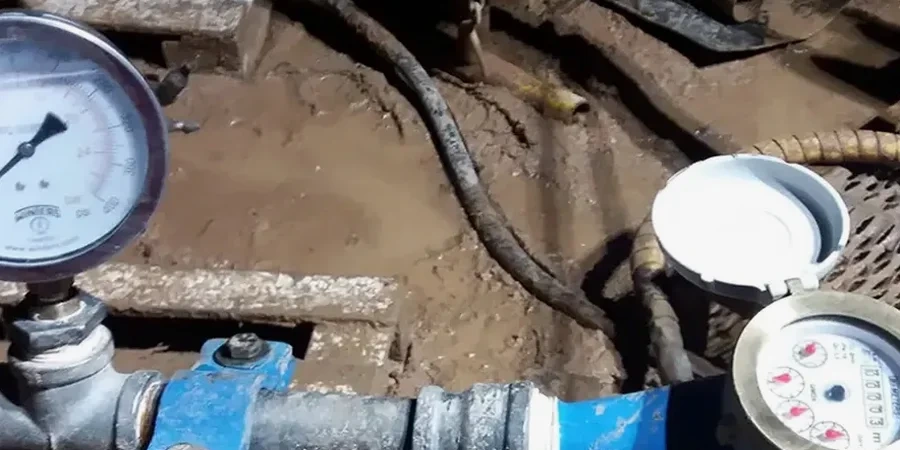
Sarnia sits on a complex glacial stratigraphy where the interface between the clay-rich till plain and the underlying bedrock aquifer creates unique groundwater challenges. The Atherley and St. Clair moraines, shaped by the retreat of the Wisconsinan ice sheet, left behind a patchwork of dense silty clays interspersed with sand stringers that can hold perched water. On a site along Vidal Street near the river, we've measured hydraulic conductivity values varying by two orders of magnitude within the same borehole. A standard geotechnical investigation might miss those lenses entirely. That's why we run in-situ permeability testing—specifically Lefranc in soils and Lugeon in rock—to give you numbers you can actually use for dewatering rate calculations or contaminant transport modeling. The Ontario Building Code and local conservation authority requirements in Lambton County often demand this level of detail when you're within the wellhead protection area or working near the St. Clair River.
A single Lefranc test in a sand lens can save weeks of over-pumping and thousands in unnecessary dewatering costs.
Local ground factors
We see it often on Sarnia jobs: a contractor assumes the till is practically impermeable, only to hit a sand seam during excavation and watch the pit flood within hours. The St. Clair till matrix itself is dense and low-permeability, but the depositional environment left behind discontinuous interbeds of glaciofluvial sand that transmit water unpredictably. If you're planning a deep excavation for a sewer trunk or a building with a sub-grade parking level, skipping the field permeability assessment means your dewatering plan is based on guesswork. A Lugeon test in the underlying bedrock can also reveal whether the rock mass needs grouting before you advance a shaft. In environmental projects, particularly around former industrial parcels south of Highway 402, accurate k values drive the fate and transport modeling that regulatory agencies review line by line. Getting it wrong can delay your Record of Site Condition by months.
Quick answers
What does a Lefranc or Lugeon test cost in Sarnia?
For a typical Lefranc test program in the Sarnia area, including mobilization, drilling access, and reporting, you're generally looking at CA$860 to CA$1,630 per test interval. Lugeon testing in rock runs toward the higher end due to the packer system setup and longer test duration. The total depends on how many intervals you need and whether we're already on site for a full drilling program.
When does the MECP or local conservation authority require in-situ permeability data?
Most often when the project falls within a wellhead protection area (WHPA) or significant groundwater recharge zone. The St. Clair Region Conservation Authority and MECP review hydrogeological studies for landfill expansions, contaminated site delineation, and major infrastructure. Direct field measurements carry more weight than lab-derived k values in permit applications.
How do you decide between a Lefranc test and lab permeability?
Lab tests on Shelby tube samples give you a point measurement in a small, potentially disturbed specimen. Lefranc testing measures the bulk hydraulic conductivity of the formation in situ, including the influence of macro-fabric features like fissures and sand seams that lab samples miss. For dewatering design or contaminant transport, we almost always recommend field testing.