← Home · Ground improvement

Vibrocompaction Design for Sarnia Soil Conditions

Together, we solve the challenges of tomorrow.

LEARN MORE →

Sarnia’s industrial backbone grew fast through the 1940s and 1950s, with refineries and chemical plants spreading across the low-lying terrain near the St. Clair River. Much of that land sits on natural alluvial sands and silts, often topped with older uncontrolled fill. When you’re placing heavy tanks or dynamic equipment on these soils, settlement becomes a real risk. Vibrocompaction design offers a practical path to densify loose granular layers before construction begins. Our team has worked on multiple brownfield expansions in the area where fill variability made standard compaction impossible. We combine site-specific borings with CPT testing to map target depths, then define grid spacing and energy input that achieves 70 percent relative density or better. For sites with deeper soft pockets, we also assess whether stone columns offer a better hybrid solution.

Deep densification by vibrocompaction can turn loose hydraulic fill into competent bearing strata without importing thousands of tonnes of engineered fill.

Process and scope

A common mistake we see in Sarnia is assuming that a few passes with a surface roller will fix deep loose zones. It won’t. The glacial and post-glacial deposits here can be loose 6 or 7 metres down, well beyond the reach of surface compaction. Vibrocompaction design addresses this by specifying the right vibrator horsepower, probe spacing, and backfill gradation. We’ve reviewed projects where skipping this step led to differential settlement under tank rings within two years of operation. Our design approach starts with grain-size curves to confirm the soil is suitable for vibratory densification — fines content above 20 percent is a red flag. When the gradation checks out, we model compaction radius and time-per-metre based on grain-size analysis and in-situ density data. On sites near the waterfront, where groundwater is high, we also factor in in-situ permeability to anticipate pore pressure dissipation rates during the process.
Vibrocompaction Design for Sarnia Soil Conditions
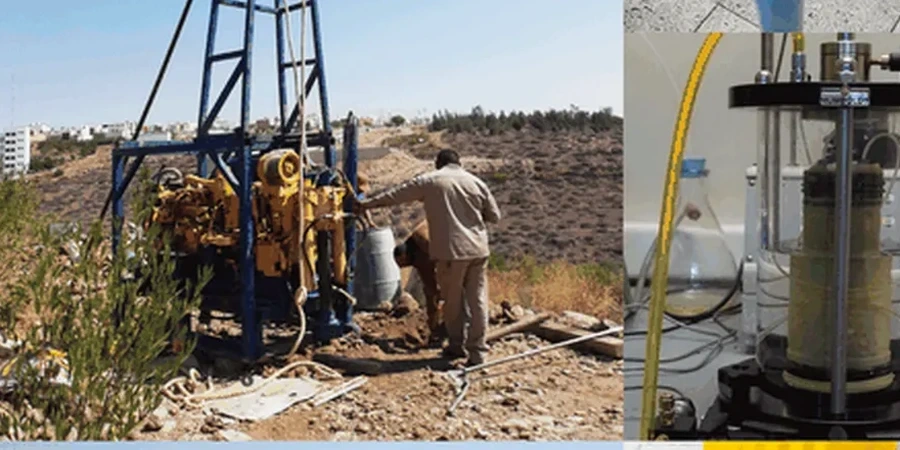
Technical reference image — Sarnia

Local ground factors

Sarnia sits on a sedimentary basin with up to 40 metres of Quaternary deposits overlying Paleozoic bedrock. Water table is often within 2 metres of the surface near the river corridor. That combination — loose saturated sand at shallow depth — triggers liquefaction potential under the seismic demands in the National Building Code of Canada. For major hazard facilities, NBCC 2020 requires site-specific assessment, not just a desk study. We’ve evaluated sites in Sarnia’s chemical valley where post-liquefaction settlement estimates exceeded 150 millimetres before treatment. Vibrocompaction design directly addresses this by increasing density and lateral stress in the ground, moving the soil from a contractive to a dilative response during shaking. After treatment, we verify improvement with SPT drilling or CPT correlation to confirm that the design void ratio has been achieved across the full treatment grid.

Need a geotechnical assessment?

Reply within 24h.

Email: [email protected]

Technical parameters

ParameterTypical value
Applicable soil typesGranular soils with fines content under 15 percent
Effective depth range3 m to 35 m below ground surface
Typical vibrator power130 kW to 250 kW electric or hydraulic
Target relative density70 percent minimum for structural support
Probe spacing (square grid)1.8 m to 3.5 m depending on soil and energy
Backfill materialClean coarse sand or gravel, D50 2–10 mm
Quality control methodPre- and post-treatment CPT or SPT correlation

Associated technical services

01

Pre-treatment site characterization

We run CPT soundings and selective borings to map loose zones, confirm grain-size suitability, and establish baseline density profiles before any vibrator arrives on site.

02

Compaction design and grid modeling

Using the characterization data, we define vibrator type, probe spacing, depth increments, and backfill gradation. We provide construction-ready drawings with treatment boundaries and sequencing.

03

Post-treatment verification testing

After compaction, we return to the site for CPT or SPT verification on a tighter grid to confirm that acceptance criteria — relative density, tip resistance, or N-value — have been met uniformly.

Applicable standards

NBCC 2020 – seismic hazard and foundation design requirements, CSA A23.3 – concrete structures referenced for foundation elements, ASTM D4253 and D4254 – maximum and minimum index density for granular soils, ASTM D5778 – electronic friction cone and piezocone penetration testing

Quick answers

What types of soil in Sarnia respond best to vibrocompaction?

Clean sands and gravels with fines content below 15 percent are ideal. Much of the hydraulic fill and alluvial sand along the St. Clair River corridor falls into this category. Silty sands with higher fines may need a stone column approach instead.

How deep can vibrocompaction treat the ground?

Standard depth vibrators can reach 35 metres, though most Sarnia projects treat the upper 10 to 20 metres where the loosest deposits are found. Depth depends on the vibrator model and the soil resistance profile.

What does vibrocompaction design cost for a typical Sarnia industrial lot?

Design costs for a site of roughly 2,000 to 5,000 square metres fall between CA$2,040 and CA$8,160, depending on the number of CPT soundings and the complexity of the treatment grid. A site-specific quote is provided after reviewing preliminary soil logs.

How long does the design phase take before field work begins?

Once site investigation data is available, design deliverables — treatment plan, grid coordinates, and acceptance criteria — are typically ready within 10 to 15 working days.

Does vibrocompaction eliminate liquefaction risk completely?

It significantly reduces risk by increasing density and lateral stress, shifting the soil response from contractive to dilative. Post-treatment verification confirms the improvement, though residual risk assessment is always part of the final report for critical structures.
Location and service area

We serve projects in Sarnia and surrounding areas.

View larger map