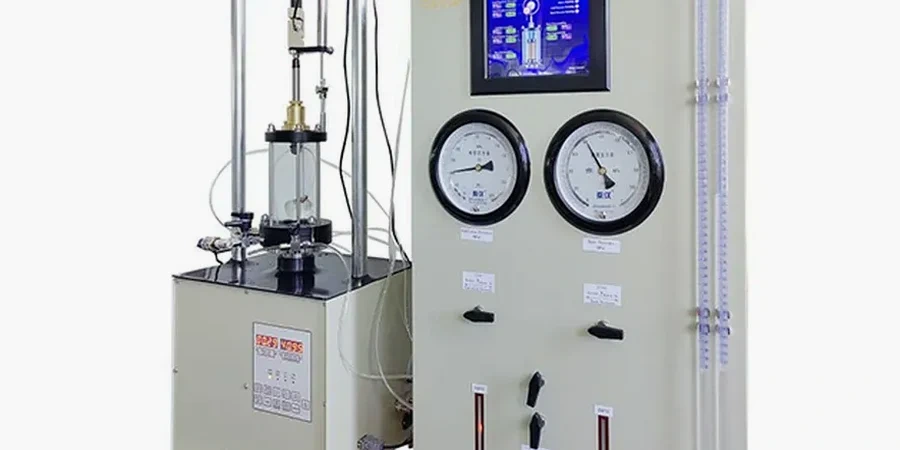
A common mistake we see in Sarnia is assuming all cohesive soils behave the same under load. An engineer might use generic shear strength values from a pocket guide, then wonder why a foundation on the city's east side performs differently than one near the St. Clair River. The reality is that Sarnia's lacustrine clays and silty deposits, shaped by glacial Lake Warren, have stress histories and drainage characteristics that demand site-specific parameters. A consolidated-undrained triaxial test with pore pressure measurement reveals the true effective stress envelope. Without it, you're either over-designing and wasting concrete, or under-designing and inheriting a long-term liability. We run multi-stage triaxial programs that give you the undrained shear strength and effective friction angle the project actually needs, not a textbook average.
A triaxial test on a Sarnia clay sample gives you two things no index test can: the effective friction angle and the undrained shear strength as a function of confining stress.
Local ground factors
The triaxial frame on our lab bench is a Bishop & Wesley-type cell, machined to hold 50 mm specimens under back pressures up to 1,000 kPa. When a Sarnia clay sample fails in undrained shear, the pore pressure spike tells a story the external load cell alone can't capture. We've seen samples from the city's waterfront area where excess pore pressure at failure was 80% of the initial effective confining stress—meaning the soil's effective stress state collapsed almost to zero, a classic sign of contractive, potentially liquefiable behavior. That's the kind of detail that separates a safe foundation design from a problem waiting for the first heavy rain or construction vibration. The triaxial test also lets us measure the Skempton A coefficient at failure, which feeds directly into undrained stability analyses for excavations and embankments. You can't get that from a vane shear or a pocket penetrometer. For projects in Sarnia's clay belt, skipping the triaxial is a risk no geotechnical report should carry.
Quick answers
What's the difference between UU, CU, and CD triaxial tests?
UU (unconsolidated-undrained) gives total-stress parameters for short-term loading on saturated clay. CU (consolidated-undrained) with pore pressure measurement gives both total and effective stress parameters—it's the standard for most foundation design in Sarnia's clay soils. CD (consolidated-drained) measures drained shear strength by shearing slowly enough to prevent pore pressure buildup. The right test depends on the soil type, drainage condition, and whether you're analyzing the construction phase or the long-term condition.
How long does a triaxial test program take?
A standard CU triaxial program with three specimens typically takes 5 to 7 working days from sample receipt to final report. Saturation and consolidation phases are the longest steps—Sarnia's silty clays often require 24 to 48 hours of back-pressure saturation to reach B-values above 0.95. CD tests take longer, usually 10 to 14 days, because the shear stage must run at a rate slow enough to maintain drained conditions. We can expedite for an additional fee if the project schedule demands it.
What sample quality do you need for a reliable triaxial test?
We need undisturbed samples—Shelby tubes (thin-wall) or block samples—with minimal disturbance. For Sarnia projects, we recommend ASTM D1587 sampling procedures with a tube area ratio below 10%. Samples should be sealed with wax or plastic caps immediately after extrusion and transported in foam-lined boxes to prevent vibration damage. We can arrange sampling through our field crew or accept samples from your driller if they follow our chain-of-custody protocol.
What does a triaxial test program cost for a typical Sarnia project?
A CU triaxial program with three confining pressures, including saturation checks, consolidation data, and Mohr-Coulomb failure envelope, ranges from CA$2,210 to CA$3,740 depending on soil type, required strain rate, and whether we need to run additional consolidation stages. Silty clays from the Sarnia area often fall in the mid-range due to the longer saturation times needed to reach B-values above 0.95. We provide a firm quote after reviewing your borehole logs and project specifications.