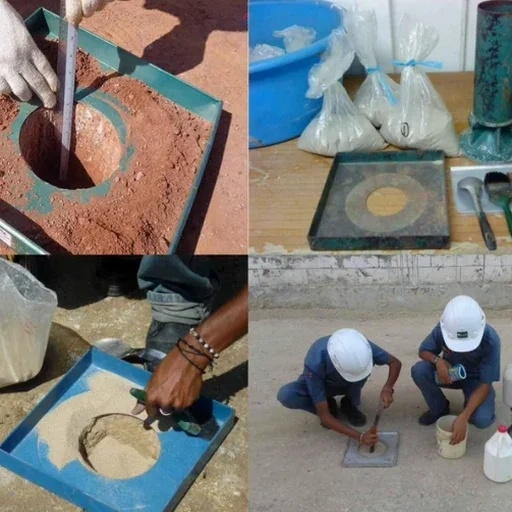
Compaction control in Sarnia’s infrastructure projects follows the parameters established by the Ontario Building Code and ASTM D1556. The city sits at an elevation of roughly 180 meters above Lake Huron, on a geological foundation of glacial till and thick silty clays. These soils demand precise verification of in-place density, particularly in the Chemical Valley where heavy industrial loads are the norm. The sand cone density test remains the most reliable field method for determining the dry density and moisture content of compacted earth, especially in trench backfill and roadway subgrades. For sites where the underlying stratigraphy is more variable, our team often integrates data from test pits to correlate surface compaction results with deeper material profiles, ensuring the entire fill section meets the project’s compaction specification.
A ninety-five percent Proctor density achieved without field verification is just a hope; the sand cone test delivers the documented proof.
Process and scope
With a population of over 70,000, Sarnia’s ongoing development along the St. Clair River corridor involves constant utility installation and road reconstruction. The heavy lacustrine clays common to this region often have an optimum moisture content ranging between 12 and 18 percent, and effective compaction requires achieving at least 95 percent of the Standard Proctor maximum dry density. The sand cone apparatus uses calibrated Ottawa sand to measure the volume of a carefully excavated test hole. The extracted material is weighed, oven-dried, and analyzed to calculate the wet and dry densities. This process provides a direct physical measurement, avoiding the calibration errors that can affect nuclear density gauges in soils with high iron content—a known issue in certain Lambton County till deposits. We verify the calibration of the sand cone device and scales before each shift, maintaining traceability to national standards through our ISO 17025 accredited laboratory procedures.