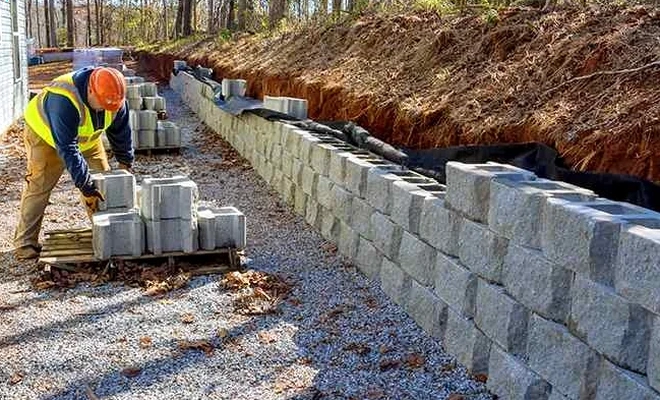
Sarnia sits roughly 180 meters above Lake Huron, but what really matters for retaining walls is what lies beneath—the dense, often slick clay deposited by glacial activity. We have been involved in projects across the city, from residential cuts near Canatara Park to commercial builds downtown, and the soil profile rarely surprises us anymore. You get that stiff upper crust, then softer saturated layers below. A design that ignores this transition zone will eventually show distress. We pair our geotechnical data with in-situ permeability testing to understand drainage demands before we even sketch the stem dimensions. That step alone prevents most long-term failures we see in Lambton County.
Sarnia clay doesn't drain. If your wall design doesn't account for hydrostatic buildup, you're not designing—you're gambling.
Quick answers
What type of retaining wall works best in Sarnia's clay soil?
Reinforced concrete cantilever walls are common here because they can handle the lateral pressures Sarnia clay exerts when saturated. We often extend the heel and add a granular drainage blanket to reduce hydrostatic load. For cuts over 4 meters, we evaluate soldier pile and lagging walls with tie-back anchors if space is tight.
Do I need a geotechnical investigation before a retaining wall design in Sarnia?
Absolutely. You cannot assume soil parameters from a regional map. We need at least one borehole at the wall location to determine the undrained shear strength profile and groundwater depth. Without that, the factor of safety you calculate is just a guess.
What does a retaining wall design typically cost in Sarnia?
Design fees for a residential or light commercial retaining wall in Sarnia generally range from CA$1,600 to CA$4,990, depending on wall height, complexity, and whether we include construction review. A straight 2-meter wall on flat ground costs less than a tiered system on a slope with surcharge loading.