← Home · Geophysics

Electrical Resistivity Testing in Sarnia — VES Surveys

Together, we solve the challenges of tomorrow.

LEARN MORE →

Sarnia sits on a complex stack of glacial till, clay plains, and shale bedrock, shaped by Lake Huron and the St. Clair River. When you punch a borehole here, you often hit water-bearing sands or saline pockets that mess with standard geotechnical assumptions. That is where electrical resistivity comes in. A vertical electrical sounding (VES) maps these layers without digging, measuring how the ground resists current flow at increasing depths. In refinery zones south of the 402, we have used VES to trace contaminant plumes moving through sandy lenses — something a test pit alone cannot catch. For deeper bedrock mapping near the Blue Water Bridge approach, combining resistivity with seismic refraction gives us a solid cross-check on depth to shale. The method works fast, leaves zero disturbance, and the data feeds directly into our geoelectric models under CSA A23.3 guidelines for foundation assessment in Lambton County soils.

Resistivity tells you what the soil is carrying in its pores — salt, hydrocarbons, or clean groundwater — before you ever break ground.

Process and scope

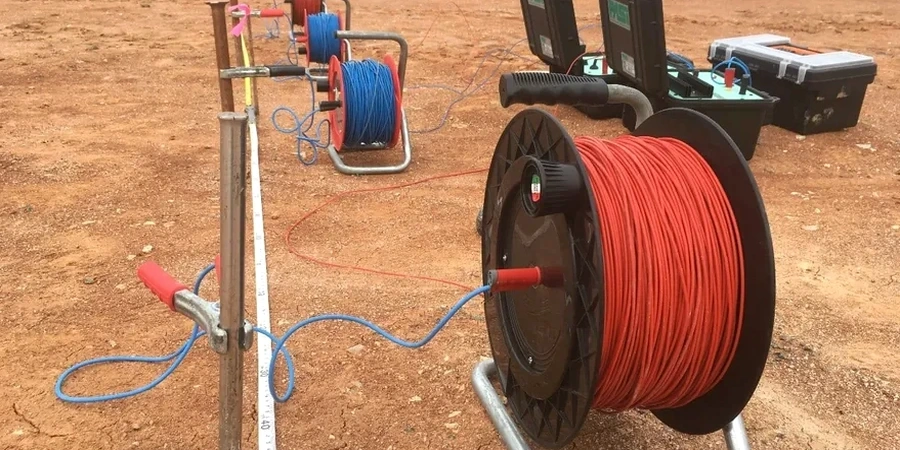
The field setup for a Schlumberger array VES in Sarnia is straightforward but demands precision. We use a 12-volt transmitter paired with a high-impedance resistivity meter, typically expanding current electrode spacing from 1.5 metres out to 200 metres depending on target depth. Four stainless steel stakes go into the ground along a straight line — two for current injection, two for potential measurement. In the clay-rich till near Centennial Park, we get strong signal-to-noise ratios; over dry sandy ridges east of Modeland Road, contact resistance spikes and we switch to saline-saturated electrodes. Each sounding generates an apparent resistivity curve that we invert with IPI2Win or Res2DInv software. The output is a layered resistivity model — useful for estimating water table depth, identifying clay versus sand interfaces, and flagging saline groundwater influence. The CPT test gives us tip resistance and friction, but resistivity adds the pore fluid chemistry dimension that mechanical tests miss entirely.
Electrical Resistivity Testing in Sarnia — VES Surveys
Technical reference image — Sarnia

Local ground factors

A project on Vidal Street a few years back taught us the hard way that ignoring resistivity data in Sarnia can backfire. The site looked clean on borehole logs — stiff clay to 12 metres. But the client skipped the VES survey, and during excavation they hit a pocket of saline groundwater migrating up from the underlying shale. Concrete footings cured poorly, and we ended up doing emergency sulphate-resistant mix redesigns. In refinery corridors and old industrial fills south of Wellington Street, hydrocarbon-impacted soils often show resistivity lows below 5 Ω·m — a clear signature that standard sampling might miss between borehole intervals. For any deep excavation near the river, we now recommend running a deep excavation monitoring program alongside resistivity profiling to track pore fluid changes as you dig.

Need a geotechnical assessment?

Reply within 24h.

Email: [email protected]

Technical parameters

ParameterTypical value
Array configurationSchlumberger (standard), Wenner (shallow targets)
Max investigation depthTypically 60–100 m with 200 m AB/2 spacing
Apparent resistivity range1 Ω·m (saline clay) to >500 Ω·m (dry sand, shale)
Electrode typeStainless steel stakes, saline-saturated for high contact resistance
Measurement protocolStacking 3–6 cycles per reading, standard deviation <2%
Inversion softwareIPI2Win, Res2DInv, EarthImager 2D
Output deliverable1D layered model, resistivity cross-sections, interpretation report

Associated technical services

01

Groundwater exploration and aquifer mapping

We run Schlumberger soundings to locate water-bearing sand and gravel lenses within the glacial till. The resistivity contrast between saturated sand (50–200 Ω·m) and clay (5–30 Ω·m) gives us a clear target for well siting and dewatering planning.

02

Contaminant plume delineation

In Sarnia's industrial south end, hydrocarbon and salt plumes depress resistivity values dramatically. We grid VES points across suspect areas, invert the data, and draw plume boundaries that guide remediation trenching and monitoring well placement.

03

Bedrock depth and soil profiling for foundations

Where the Kettle Point shale lies within 30 metres of surface, resistivity jumps above 100 Ω·m. We map this interface for footing design, pile socket estimates, and seismic site classification under NBCC requirements.

Applicable standards

NBCC 2015 — Structural and geotechnical design provisions, CSA A23.3 — Design of concrete structures, exposure classes for sulphate attack, ASTM D6431 — Standard guide for using the direct current resistivity method for subsurface investigation

Quick answers

What does a VES survey cost in Sarnia?

A typical vertical electrical sounding with Schlumberger array, including field acquisition, data inversion, and a report with interpreted geoelectric layers, runs between CA$960 and CA$1,440. The final number depends on maximum depth, number of soundings, and site access conditions across the city.

How deep can electrical resistivity see in Lambton County soils?

With a maximum current electrode half-spacing of 200 metres, we routinely investigate down to 60–100 metres. In Sarnia's glacial drift over shale, the practical limit is often the bedrock interface, which we can resolve clearly when the resistivity contrast exceeds 3:1.

Does frozen ground affect VES measurements?

Yes, frozen surface layers increase contact resistance and can distort shallow readings. We schedule Sarnia VES surveys between April and November when possible, or use saline electrode coupling and longer injection times if winter work is unavoidable.

Can resistivity distinguish between clay and silt?

Not reliably on its own — both fine-grained materials can show overlapping resistivity ranges between 10 and 40 Ω·m depending on pore water salinity. We pair VES with grain size analysis from borehole samples to confirm the lithology behind the resistivity signature.

How long does a single VES sounding take on site?

A standard Schlumberger sounding to 100-metre half-spacing takes about 45 to 90 minutes once the array is laid out. Site setup adds 20 minutes; urban locations near Sarnia's industrial corridors may take longer if we need to avoid buried utilities.
Location and service area

We serve projects in Sarnia and surrounding areas.

View larger map