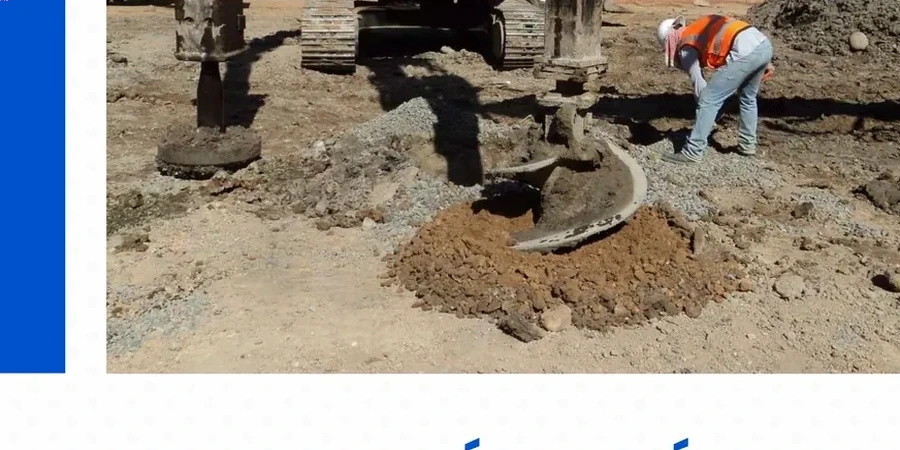
The soil conditions between Sarnia’s Chemical Valley industrial corridor and the residential subdivisions near Bright’s Grove couldn’t be more different: one sits on deep, compressible clay; the other overlies layered silts and sand lenses. Designing a stone column scheme that works in both settings demands more than a textbook approach — it requires local borehole data, an understanding of seasonal groundwater swings tied to Lake Huron, and a realistic assessment of long-term settlement under structural loads. We use site-specific CPT and SPT data to calibrate column spacing, diameter, and depth so that the ground improvement actually performs over the 50‑year design life the National Building Code of Canada expects. For projects where column installation encounters unexpected organics, we often recommend pairing the design with a test pit investigation to verify stratigraphy at the vibro-replacement rig access points before full mobilization.
A properly designed stone column grid in Sarnia clay can cut differential settlement by half, turning marginal land into a buildable asset.
Process and scope
The 2020 National Building Code of Canada (NBCC) and CSA A23.3 set clear performance criteria for ground improvement under shallow foundations, and those criteria carry extra weight in Sarnia because much of the city is underlain by glaciolacustrine clay that can lose strength when remolded during vibroflot penetration. Our design process accounts for that sensitivity by varying the stone column grid from 1.8‑m triangular spacing under isolated footings to 2.5‑m rectangular arrays beneath floor slabs, always checking the unit cell against the Priebe method and field modulus from dilatometer results. We also control the aggregate specification: clean, hard, angular crushed stone graded 25‑50 mm, placed in lifts with real‑time amperage monitoring so the column diameter stays within 10 percent of the design value. The result is a ground improvement package that reduces total settlement by 40‑60 percent compared to untreated ground, which often eliminates the need for deep piles on mid‑rise commercial builds.
Quick answers
How much does stone column design cost for a typical Sarnia commercial lot?
For a standalone design package covering a 1,500–4,000 m² commercial building footprint, fees typically range from CA$1,900 to CA$7,840 depending on the number of CPT soundings required, the complexity of the loading layout, and whether construction‑phase QA/QC supervision is included.
How long does the design process take once site data is available?
With complete field data in hand, we deliver a feasibility memorandum within two weeks and full issued‑for‑construction drawings within four weeks. Projects requiring detailed 3D finite element settlement analysis may extend the schedule by one additional week.
What site investigation data do you need before starting the stone column design?
We require continuous CPT soundings reaching at least two column diameters below the intended column tip depth, plus one soil boring with Shelby tube samples per 800 m² for consolidation and classification testing. MASW or seismic refraction lines are helpful where bedrock depth varies sharply near the St. Clair River bluffs.
Can stone columns be installed through the fill layers common in Sarnia’s older industrial zones?
Yes, but the fill must be carefully characterized first. Rubble, buried concrete, and chemical waste residues in the Vidal Street corridor can obstruct the vibrator; we specify a pre‑drilling program and aggregate‑compatible stone that resists sulfate attack confirmed by CSA A23.2‑9A testing.
What acceptance testing verifies that the stone columns meet the design intent?
We typically specify zone CPT soundings between columns at a rate of one test per 300 m² of treated area, comparing the post‑treatment tip resistance profile against the design target. For critical structures, we add plate load tests on single columns to directly measure the modulus improvement.