← Home · Slopes & Walls

Slope Stability Analysis for Sarnia Projects

Together, we solve the challenges of tomorrow.

LEARN MORE →

Sarnia sits roughly 190 meters above sea level, perched on the edge of the St. Clair River. That elevation looks modest until you factor in the riverbank erosion rates that have shaped this city since the 1850s. For any excavation deeper than 1.2 meters in Sarnia’s glaciolacustrine clays, the stability window tightens fast. We run slope stability analysis that maps the failure envelope before a bucket hits the ground. The approach integrates Sarnia’s known stratigraphy—stiff clay till overlying Kettle Point shale—with pore pressure data collected on site. The result is a factor of safety you can defend to the municipality and the consulting engineer. When the stratigraphy turns complex, we often pair the analysis with a CPT test to capture continuous soil behavior without gaps, or with test pits when the upper two meters need visual confirmation of fill and organics.

In Sarnia clay, the factor of safety drops 15% within 72 hours of cutting a vertical face—timing the analysis matters as much as the method.
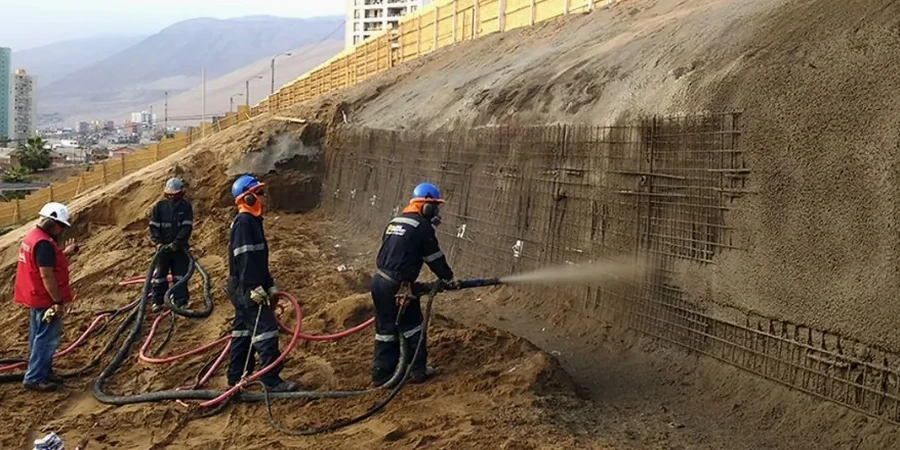
Process and scope

Sarnia’s overburden tells a glacial story: up to 40 meters of clay and silt deposited by proglacial Lake Arkona, resting directly on Devonian shale. The clay’s liquidity index runs close to 1.0 in the upper 3 meters, meaning it behaves almost like a viscous fluid when remolded. A standard slope stability analysis here must capture three realities: the seasonal groundwater perched above the clay, the pre-sheared planes in the St. Joseph Till, and the rapid drawdown condition along the St. Clair River after spring melt. We model circular and non-circular slip surfaces using limit equilibrium methods, applying the NBCC 2015 seismic hazard values for Sarnia’s latitude. Where the riverbank geometry demands it, we incorporate stone columns as a ground improvement strategy to raise the undrained shear strength before benching the slope. The analysis output includes a sensitivity matrix showing how the factor of safety changes with a 0.5-meter rise in the phreatic surface—critical data for the drainage design.
Slope Stability Analysis for Sarnia Projects
Technical reference image — Sarnia

Local ground factors

The north-end residential subdivisions near Blackwell Road sit on dense clay till that drains reasonably well—stability risks there tend to be manageable with standard 2H:1V cut slopes. Move south toward the Chemical Valley industrial corridor, and the profile shifts. The underlying Kettle Point shale weathers into a slick, low-friction surface when exposed to air and moisture. On a 2018 warehouse expansion near Vidal Street, a temporary 4-meter cut in weathered shale began spalling within 48 hours of exposure. The remediation involved flattening the slope angle and adding a drainage bench midway up the face. In Sarnia, the difference between a stable excavation and a costly setback often comes down to whether the analysis accounted for shale deterioration rates. We model both short-term undrained conditions and long-term drained behavior, because the clay here loses suction slowly over months, not days.

Need a geotechnical assessment?

Reply within 24h.

Email: [email protected]

Explanatory video

Technical parameters

ParameterTypical value
Analysis methodLimit equilibrium (Bishop, Spencer, Morgenstern-Price)
Slip surface geometryCircular and non-circular (block/wedge search)
Seismic coefficient (kh)Per NBCC 2015 Sarnia hazard spectrum
Pore pressure modelPiezometric line or ru coefficient from field data
Minimum factor of safety (static)1.5 (permanent), 1.3 (temporary)
Minimum factor of safety (seismic)1.1 per CSA A23.3 recommendations
Soil strength inputEffective stress (c', φ') from CIU triaxial

Associated technical services

01

Riverbank Stability Assessment

For properties within 30 meters of the St. Clair River or Talfourd Creek. Models rapid drawdown, toe erosion, and long-term recession rates.

02

Temporary Excavation Slope Design

Maximum allowable slope angles for construction cuts in Sarnia clay till and weathered shale, with drainage bench specifications.

03

Permanent Embankment Analysis

Stability under static and seismic loading for roadway embankments, detention pond berms, and industrial fill pads.

04

Slope Instrumentation Planning

Inclinometer and piezometer layout to monitor lateral movement and pore pressure during staged excavation adjacent to existing structures.

Applicable standards

NBCC 2015 – Seismic hazard values for Sarnia region, CSA A23.3 – Design of concrete structures (retaining elements), ASTM D7181 – Consolidated undrained triaxial compression test, ASTM D4767 – Consolidated undrained triaxial for cohesive soils

Quick answers

What does a slope stability analysis cost for a typical Sarnia residential lot?

For a single-family lot requiring a cut or fill analysis, budget between CA$1,630 and CA$4,920. The spread depends on whether we need one borehole or three, and whether the slope geometry triggers a seismic review under NBCC 2015.

How deep can I excavate before Sarnia clay requires a stability analysis?

The Ontario Building Code triggers a geotechnical review for excavations deeper than 1.2 meters in cohesive soil. In Sarnia’s clay, we recommend analysis starting at 1.5 meters if the cut face stays open more than 14 days.

Do you model the weathered shale contact in the analysis?

Yes. The clay-shale interface is a common failure plane in Sarnia. We assign residual friction values to that surface based on direct shear testing of the weathered zone, which typically falls between 12 and 18 degrees depending on the degree of decomposition.

Location and service area

We serve projects in Sarnia and surrounding areas.

View larger map