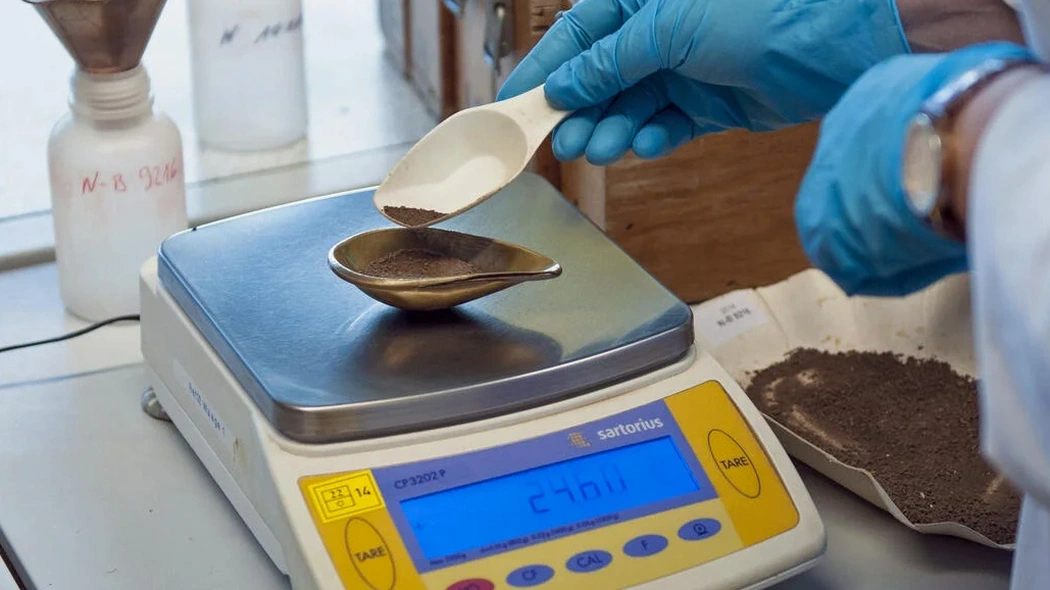
Beneath Sarnia's industrial grid lies a complex stratigraphy of glacial Lake Warren clays and silts, often interbedded with fine sand. The city's average elevation sits just over 180 meters above sea level, with groundwater commonly encountered within 2 to 3 meters of surface. When a contractor hits a lens of varved clay during excavation, the particle size distribution dictates everything from dewatering strategy to compaction specification. A combined sieve and hydrometer analysis per ASTM D6913 and D7928 resolves the full grain size curve—from gravel down to colloidal clay—so the engineer knows exactly what the formation will do under load or saturation. For projects near the St. Clair River, where stratigraphy shifts laterally within a few meters, we routinely pair grain size data with in-situ permeability testing to confirm drainage behavior matches the gradation model.
In Sarnia's layered glacial deposits, the fines fraction controls everything: 38 percent clay can turn a simple slab into a structural mat.
Process and scope
A recent warehouse expansion off Highway 40 exposed a textbook Sarnia problem: fill over a desiccated clay crust, underlain by wet, laminated silty clay. The structural engineer needed both shear strength and drainage inputs. We ran a full sieve stack on the granular fill, then hydrometer sedimentation on the minus 75-micron fraction. The result showed 38 percent passing the 2-micron mark—active clay, with a plasticity index above 25. That single data point changed the floor slab design from a standard slab-on-grade to a structurally reinforced mat. When the gradation curve indicates gap-graded or poorly draining material, we often recommend following up with
Atterberg limits to quantify the plasticity of the fines fraction, which directly correlates to swell potential in Sarnia's seasonally wet clay basins. Our in-house lab processes samples within 48 hours, delivering a combined curve with D10, D30, D50, D60, and the coefficient of uniformity, all backed by CSA A23.3 reference standards for aggregate qualification.
Local ground factors
The hydrometer setup we use in the field lab is a 152H-type soil hydrometer in a 1000 mL sedimentation cylinder, with sodium hexametaphosphate as the dispersant. Temperature control matters here: the lab runs at a steady 22°C, but we record the actual suspension temperature every hour and correct the readings per ASTM D7928. A common failure mode in Sarnia is skipping the hydrometer entirely and reporting only the sieve portion—this misses the entire clay fraction. When a grain size curve truncates at the No. 200 sieve, you lose the data that governs permeability, frost heave susceptibility, and long-term consolidation rate. In a city where frost penetrates over a meter in an average winter, that omission can lead to pavement heave within two seasons. We report the full curve, zero to 100 percent passing, every time.
Quick answers
What does a combined sieve and hydrometer test cost in Sarnia?
A full combined analysis (sieve stack plus hydrometer sedimentation on the fines fraction) typically runs between CA$150 and CA$250 per sample, depending on whether the material is predominantly granular or fine-grained and whether expedited turnaround is required.
How much sample material do you need for the hydrometer portion?
We need about 500 grams of representative fine-grained material from the field sample. For the complete combined test, submit a 2 to 5 kilogram bulk sample in a sealed bag, and we split it in the lab according to ASTM D6913 procedures.
Which ASTM method do you use for the hydrometer analysis?
We run the sedimentation analysis per ASTM D7928, using a 152H hydrometer with sodium hexametaphosphate dispersant. All readings are temperature-corrected, and we report the full particle size distribution curve from 75 microns down to the 1-micron clay fraction.
Why do I need the hydrometer if I already have the sieve results?
The sieve stops at the No. 200 (75-micron) opening. Everything finer—silt and clay—passes through. In Sarnia's glacial lake deposits, the clay fraction often exceeds 30 percent and controls settlement rate, frost heave, and permeability. Without the hydrometer curve, you are designing blind on the material that governs long-term performance.