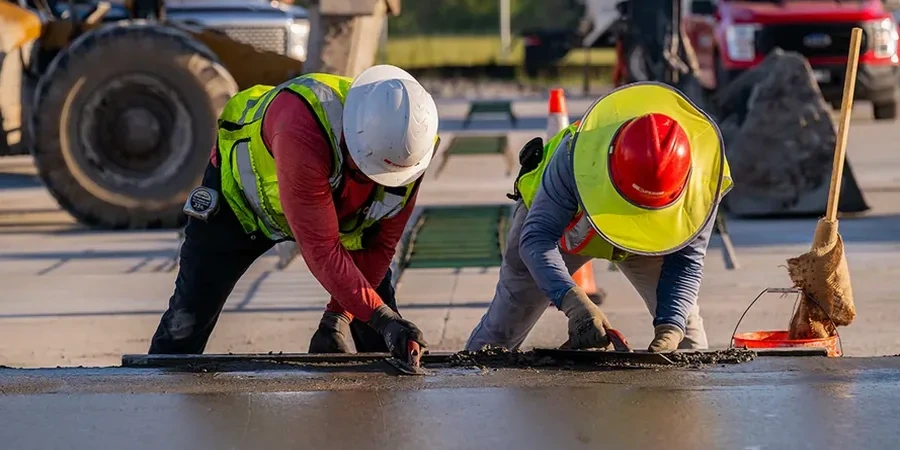
The slab thickness design starts with the concrete batch plant setup — volumetric mixers calibrated to CSA A23.3, slump cones and air meters checked every 50 cubic metres on Sarnia-Lambton jobs. For rigid pavement, joint layout dictates 90% of long-term performance, so we model dowel bar placement and tie bar spacing in BIM before a single form is set. The subgrade beneath Highway 40 industrial parks is rarely uniform; we run plate load tests and DCP soundings at 30-metre intervals to catch soft pockets in the glacial till. Where clay moisture content exceeds 25%, the rigid pavement section gets an open-graded drainage layer and edge drains tied to municipal storm sewers — standard practice on Vidal Street and Confederation Line expansions. The slipform paver runs on stringline control, and we verify edge slump and air void spacing in the plastic concrete before the curing compound goes on.
In Sarnia's clay, a rigid pavement slab is only as good as the subbase drainage and the joint load transfer system beneath it.
Quick answers
What does rigid pavement design cost for a typical Sarnia industrial parking lot?
For a Sarnia industrial parking lot — say 2,000 to 5,000 square metres — the rigid pavement design package runs between CA$2,860 and CA$5,200. That includes subgrade investigation, k-value determination, slab thickness design per AASHTO 93, joint layout drawings, and concrete mix specification. A full QA/QC package with on-site testing during the pour adds approximately CA$1,800 to CA$4,330 depending on the number of truck loads and the testing frequency required by the spec.
How do Sarnia's freeze-thaw cycles affect rigid pavement durability?
Sarnia averages 60 to 80 freeze-thaw cycles each winter, which puts air-entrained concrete to the test. We specify a minimum 5.5% air content and a spacing factor below 0.20 mm in the hardened paste — verified by ASTM C457 petrographic analysis — to ensure the slab survives 300+ cycles without scaling. The bigger issue is subgrade frost heave: in Sarnia's silty clays, we design the granular subbase thickness to prevent the frost line from reaching frost-susceptible soil, typically requiring 450 to 600 mm total granular depth under outdoor slabs.
Which concrete mix specification works best for Sarnia's climate and heavy truck traffic?
We specify a 32 MPa minimum 28-day compressive strength with Type GU cement (CSA A3001), 5.5-7% entrained air, and a maximum 0.45 water-cement ratio. For Chemical Valley access roads with constant tanker traffic, we push the flexural strength to 4.5 MPa at 28 days — tested by third-point loading per ASTM C78 — and use a 25 mm maximum aggregate size to improve fracture toughness. De-icing salt exposure requires supplementary cementitious materials: 25% slag or 15% fly ash replacement to boost chloride resistance.
How long does the rigid pavement design process take from site investigation to final drawings?
For a standard Sarnia commercial project, the timeline breaks down as follows: field investigation and sampling (2-3 days), laboratory testing including CBR, k-value, and concrete trial mixes (7-10 working days), analysis and slab design per AASHTO 93 with local calibration (3-4 days), and preparation of stamped design drawings with joint details (2-3 days). The full package is typically ready in 3 weeks. We can accelerate to 10 working days for urgent projects by running lab tests in parallel with the design work.
Do you handle both design and construction-phase testing for rigid pavement in Sarnia?
Yes. We provide a turnkey service: geotechnical investigation, rigid pavement design, and on-site QA/QC during construction. Our technicians are on the paver line measuring slump, air content, and concrete temperature per CSA A23.1, casting beams for flexural strength, and verifying dowel bar alignment with MIT Scan devices. We also run FWD testing on the completed pavement to confirm the in-situ modulus matches the design assumptions. Having the same team handle design and QA closes the feedback loop and catches deviations before they become defects.