← Home · Foundations

Pile Foundation Design in Sarnia: Geotechnical Solutions for Industrial and Waterfront Projects

Together, we solve the challenges of tomorrow.

LEARN MORE →

Sarnia sits at the confluence of Lake Huron and the St. Clair River, a geography that shapes everything underground. Beneath the surface, glacial deposits create a layered profile of soft clays, silts, and occasional sand lenses. For any structure heavier than a single-family home, shallow footings often hit bearing capacity limits fast. That is where deep foundation expertise becomes essential. Our team designs pile systems that transfer loads through the weak near-surface soils down to competent strata. We do not guess at depth; every design starts with site-specific investigation data. In Sarnia’s Chemical Valley, where settlement intolerance is measured in millimetres, we combine field testing with laboratory analysis to model pile behaviour under both static and seismic conditions. The result is a foundation that works with the local geology, not against it.

Pile design in Sarnia is governed by soft clay behaviour at depth, not by structural capacity of the pile itself.

Process and scope

A mistake we see too often in Sarnia is assuming all piles perform the same way. A driven H-pile in dense till behaves nothing like a bored cast-in-place pile in saturated silt. Contractors occasionally default to a “standard” pile type because it worked on the last job, without verifying if the soil profile matches. That shortcut leads to excessive settlement, pile damage during driving, or concrete necking during extraction. Our design process eliminates guesswork. We start by correlating in-situ SPT drilling data with undrained shear strength profiles, then select pile type, diameter, and embedment depth that match the actual stratigraphy. When granular layers dominate, we often specify driven piles with dynamic monitoring. For sensitive clays near the St. Clair River, bored piles with temporary casing prevent collapse. Every design includes axial capacity calculations per NBCC, lateral load analysis, and group efficiency checks when piles are closely spaced.
Pile Foundation Design in Sarnia: Geotechnical Solutions for Industrial and Waterfront Projects
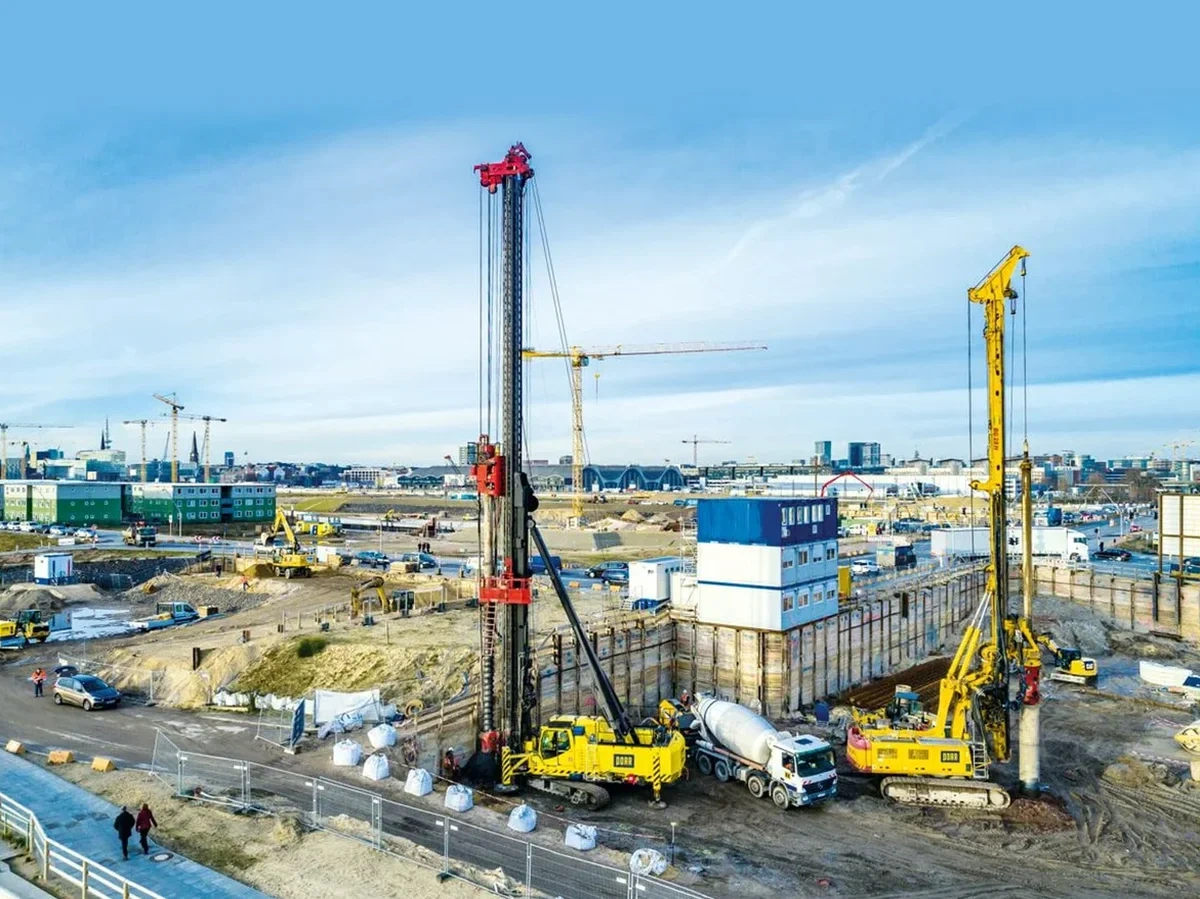
Technical reference image — Sarnia

Local ground factors

A 14-storey mixed-use building planned along Sarnia’s waterfront hit an unexpected problem during pre-construction: the geotechnical report flagged a 6-metre-thick layer of compressible organic silt at 15 metres depth, directly above the bearing stratum. The initial pile design had assumed uniform clay and specified a tip elevation that would have left piles floating in that silt layer, risking post-construction settlement of 40 millimetres or more. We redesigned the pile group to penetrate deeper, adding 8 metres of embedment into dense till, and specified pre-augering through the silt to reduce driving resistance. The solution added upfront cost but eliminated a structural risk that would have been far more expensive to fix later. In Sarnia’s variable subsurface, a single missed layer can compromise an entire foundation system. That kind of detail is why we insist on combining CPT soundings with laboratory consolidation tests before finalizing any pile design.

Need a geotechnical assessment?

Reply within 24h.

Email: [email protected]

Technical parameters

ParameterTypical value
Design standardNBCC 2020, CSA A23.3:19
Pile types designedDriven H-piles, pipe piles, bored cast-in-place, helical piles
Axial capacity methodStatic analysis with CPT/Su correlations, confirmed by CAPWAP
Settlement analysist-z curves, elastic continuum, consolidation settlement for clay layers
Lateral load analysisp-y curves per Reese & Van Impe, LPILE modelling
Seismic designSite Class per NBCC Table 4.1.8.4.A, kinematic interaction considered
Group efficiencyConverse-Labarre, Feld’s rule, or 3D FE analysis for large groups
Corrosion protectionSacrificial steel thickness per CSA G40.21 for waterfront piles

Associated technical services

01

Axial and Lateral Pile Capacity Design

We calculate ultimate and allowable capacities using site-specific soil parameters from SPT, CPT, and laboratory testing. Designs account for negative skin friction in consolidating clays, scour depth near the St. Clair River, and long-term creep settlement. Lateral load analyses use p-y curves calibrated to Sarnia’s soft clay response, with output verified against LPILE or GROUP software.

02

Construction Monitoring and Pile Testing

Design does not end with a report. We provide field oversight during pile installation, including dynamic testing with PDA and CAPWAP analysis to confirm capacity. For critical structures, we specify static load tests per ASTM D1143 and cross-hole sonic logging for bored piles. Every test result feeds back into the design model to verify assumptions made during the geotechnical phase.

Applicable standards

NBCC 2020 (National Building Code of Canada), CSA A23.3:19 (Design of Concrete Structures), CSA S16:19 (Design of Steel Structures), ASTM D1143 (Standard Test Methods for Deep Foundation Elements Under Static Axial Compressive Load)

Quick answers

What is the typical cost range for pile foundation design in Sarnia?

Pile foundation design fees in Sarnia generally range from CA$2,620 to CA$9,810 depending on project complexity. A straightforward design for a single pile-supported column with existing site data falls at the lower end. Larger projects requiring multiple pile types, lateral load analysis, seismic evaluation, and construction monitoring move toward the upper range. This covers geotechnical analysis, capacity calculations, design drawings, and field support during installation.

Which pile type works best for Sarnia’s soil conditions?

There is no universal answer. In the dense till underlying much of Sarnia, driven H-piles or closed-end pipe piles perform reliably and can achieve high capacities. For sites near the waterfront with thick soft clay layers, bored cast-in-place piles with temporary casing offer better control and reduce the risk of ground heave during installation. Helical piles suit lighter structures and limited access sites. The right choice depends on your specific stratigraphy, load requirements, and site constraints.

How do you account for seismic loads in Sarnia pile designs?

Sarnia is in a region of moderate seismicity, and NBCC 2020 requires seismic design for most structures. We determine the Site Class based on shear wave velocity or SPT N-values from your geotechnical investigation, then apply the appropriate spectral acceleration values. For pile design, this means checking lateral capacity under seismic loading, evaluating kinematic interaction where piles pass through soft layers into stiff bearing strata, and ensuring ductile detailing per CSA A23.3 for concrete piles.
Location and service area

We serve projects in Sarnia and surrounding areas.

View larger map