← Home · Geophysics

Seismic Tomography (Refraction/Reflection) in Sarnia, ON

Together, we solve the challenges of tomorrow.

LEARN MORE →

Sarnia presents a tale of two geologies. The industrial waterfront along the St. Clair River, with its legacy fill and buried infrastructure, demands a completely different imaging strategy than the residential subdivisions expanding into the clay plains south of Highway 402. In the river corridor, we often deploy high-resolution reflection profiling to trace buried concrete structures and old sheet pile lines, while the southern developments rely on seismic refraction to map the depth to competent shale bedrock beneath the glaciolacustrine deposits. The contrast is stark, but the common thread is the need for continuous subsurface data—something that a seismic refraction survey provides far more efficiently than a grid of boreholes alone. In a city where the water table sits barely two meters below grade, understanding the velocity structure of the saturated overburden directly informs both excavation design and foundation selection.

A seismic velocity of 1800 m/s in Sarnia's overburden often indicates dense till, not bedrock—misidentifying this contact can double your excavation costs.

Process and scope

In Sarnia, we frequently encounter a situation where the standard penetration test (SPT) refuses at what appears to be bedrock, yet the seismic velocity tells a different story. What the driller calls 'bedrock' is often a dense till layer or a large glacial erratic within the St. Joseph Till, and the true Paleozoic shale contact lies several meters deeper. Refraction tomography resolves this ambiguity by mapping the 2D velocity field, clearly distinguishing between compacted till (Vp ~1800-2400 m/s) and competent shale (Vp >3000 m/s). This distinction is critical for projects requiring rock socketing or bedrock excavation estimates. When the site geometry permits, we pair the seismic data with in-situ permeability testing in overburden wells, because the fracture flow regime in the underlying Kettle Point Formation often controls dewatering requirements. For deeper targets or sites with significant ambient noise from the Chemical Valley plants, we shift to reflection methods to image stratigraphic boundaries beyond 30 meters depth.
Seismic Tomography (Refraction/Reflection) in Sarnia, ON
Technical reference image — Sarnia

Local ground factors

The National Building Code of Canada (NBCC 2020) classifies Sarnia under a moderate seismic hazard zone, but the real risk here is not ground shaking—it is the amplification potential of the deep post-glacial clay deposits. These soft, normally consolidated clays can generate significant site effects that a simple Vs30 measurement from a single borehole might miss. Our seismic tomography surveys provide a continuous shear-wave velocity profile across the entire site, capturing lateral variations that affect the seismic site classification per NBCC Table 4.1.8.4. Relying solely on sparse borehole data in the variable Lambton County drift deposits introduces a classification uncertainty that can cascade into overly conservative—or dangerously unconservative—structural designs. The tomography data also feed directly into a seismic microzonation study when the project scale warrants a detailed assessment of ground response across the property.

Need a geotechnical assessment?

Reply within 24h.

Email: [email protected]

Technical parameters

ParameterTypical value
Maximum investigation depth (refraction)30 to 45 m below grade
Maximum investigation depth (reflection)100+ m below grade
Typical geophone spacing2 to 5 m (project-dependent)
Energy sourceAccelerated weight drop or sledgehammer
P-wave velocity in saturated clay1500 to 1750 m/s (typical)
P-wave velocity in shale bedrock2800 to 3600 m/s
Data processingTomographic inversion (refraction), CMP stacking (reflection)

Associated technical services

01

Refraction tomography for bedrock mapping

2D P-wave and S-wave velocity profiling to delineate the overburden-bedrock interface, identify paleochannels filled with soft sediment, and detect zones of fractured or weathered shale. Essential for foundation design, pipeline routing, and pre-excavation site characterization in Sarnia's glacial terrain.

02

High-resolution reflection profiling

Deep imaging of stratigraphic boundaries, buried valleys, and subsurface structures beyond the penetration limit of refraction methods. Applied in the industrial core and along the riverfront where anthropogenic fill and infrastructure complicate the near-surface velocity model.

03

Crosshole and downhole seismic testing

Direct measurement of compression and shear wave velocities between boreholes for precise dynamic modulus calculation. Used when project specifications require site-specific Vs profiles for liquefaction assessment or seismic site classification under the NBCC.

Applicable standards

NBCC 2020 (National Building Code of Canada, seismic provisions), CSA A23.3-19 (Design of Concrete Structures, foundation requirements), ASTM D5777-18 (Standard Guide for Using the Seismic Refraction Method), ASTM D7128-18 (Standard Guide for Using the Seismic Reflection Method), MTO LS-219 (Ontario Ministry of Transportation geophysical testing)

Quick answers

What is the typical cost range for a seismic tomography survey in Sarnia?

Seismic tomography projects in the Sarnia area generally range from CA$3,460 to CA$6,220, depending on the survey length, depth of investigation required, and whether you need refraction only or a combination of refraction and reflection. A short refraction line for a single-family lot costs less than a multi-line reflection survey with tomographic processing across a commercial site. We always provide a fixed-price proposal after reviewing the site geometry and project objectives.

How does seismic refraction differ from reflection, and which one do I need for my Sarnia project?

Refraction images the subsurface by tracking critically refracted waves along velocity boundaries, making it ideal for mapping the top of bedrock and the water table within about 30 meters of the surface. Reflection uses near-vertical seismic echoes to image deeper interfaces, similar to sonar. In Sarnia, we recommend refraction for most shallow foundation and excavation projects. Reflection becomes the better choice when you need to see stratigraphy below 30 meters, or when site noise from the Chemical Valley operations masks the weaker refracted arrivals.

Can seismic tomography work on paved or concrete-covered sites in Sarnia's industrial areas?

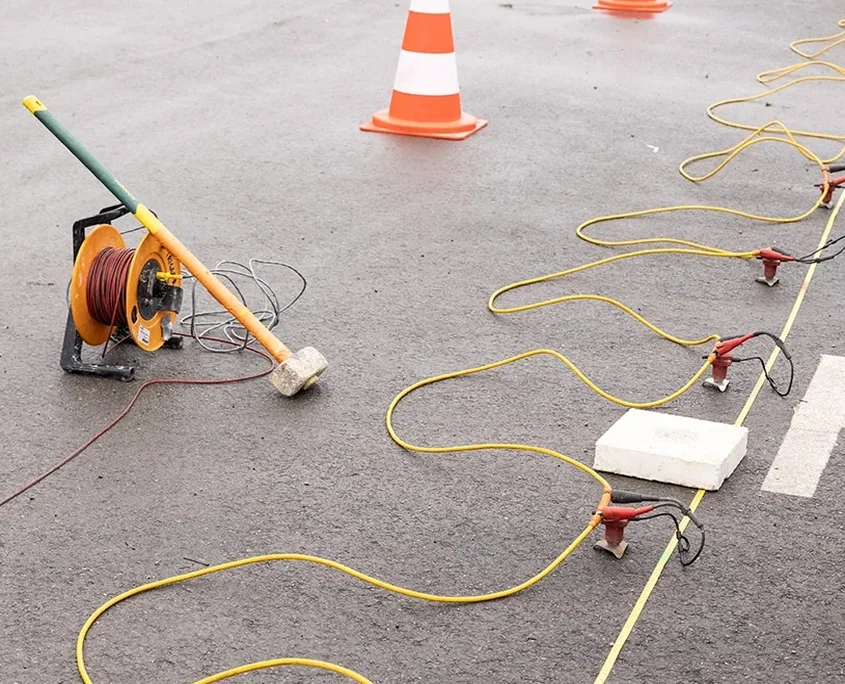
Yes, but with modifications. On asphalt or concrete, we cannot plant geophones directly into the ground, so we use base plates coupled to the surface with a viscous couplant or drill small pilot holes through the pavement at each station. The data quality on paved surfaces is generally good for refraction work, though reflection surveys lose some high-frequency content. We have completed multiple surveys inside active refinery and chemical plant sites in the Sarnia area using these adapted techniques.

How long does a seismic tomography survey take, and what access do you need?

A single refraction line of 115 meters typically requires half a day of field work, including setup, data acquisition, and demobilization. Larger grids with multiple intersecting lines can extend to two or three days. We need linear access along the survey line, roughly 2 meters wide, free of heavy vehicle traffic during the active shooting. Post-processing and interpretation add approximately one week, and we deliver the final report with 2D velocity cross-sections and interpreted geological boundaries.
Location and service area

We serve projects in Sarnia and surrounding areas.

View larger map