Geotechnical Engineering in Sarnia

Together, we solve the challenges of tomorrow.

LEARN MORE →

The National Building Code of Canada sets the baseline, but in Sarnia the ground writes its own rules. We are dealing with deep lacustrine clay deposits that can exceed 30 meters in thickness, overlying glacial till. Any structure heavier than a single-family home demands a soil mechanics study that goes beyond standard bearing capacity. The interaction between the stiff upper crust and the underlying soft, normally consolidated clay is what governs settlement here. Before finalizing a foundation design, we typically correlate data from a CPT test with our laboratory program to map the overconsolidation ratio across the site, because variations in Sarnia can be sharp even within a single city block.

In Sarnia, the difference between a stable mat foundation and differential settlement is often just a 2% variation in clay moisture content.
Geotechnical Engineering in Sarnia
Technical reference image — Sarnia

Process and scope

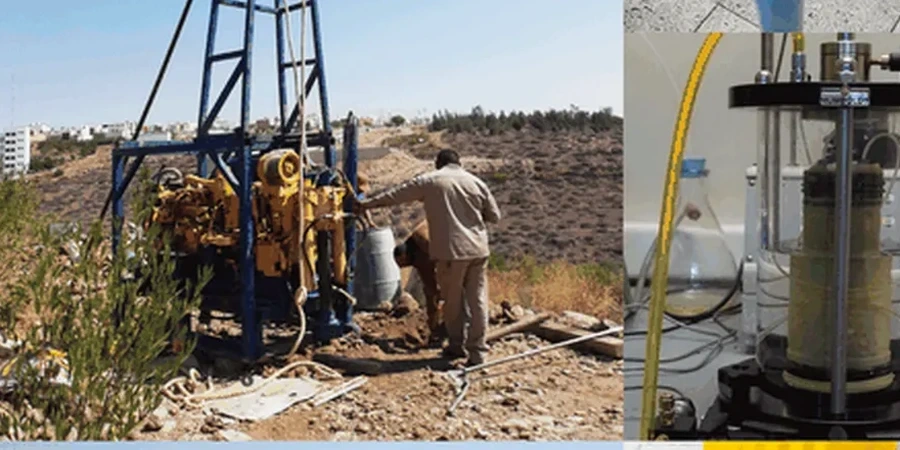
The core of the investigation happens on a triaxial frame capable of consolidated-undrained testing with pore pressure measurement. We extract thin-walled Shelby tube samples from the clay layer, taking extreme care to avoid disturbance during transport from the Sarnia site to our lab. In the lab, incremental loading and shearing phases replicate the stress path the soil will experience under the new load. For the granular lenses found within the till, we run sieve analysis and often a grain size distribution test to quantify the matrix. When the project involves deep excavations near the St. Clair River, we also run in situ permeability tests using a standpipe or piezometer to assess groundwater flow rates, which are critical for designing a dewatering system that does not destabilize adjacent structures.

Local ground factors

A common error we encounter in Sarnia is treating the stiff surface crust as a competent bearing layer for strip footings without checking what lies beneath. The crust can be 2 to 4 meters thick and feels solid under the excavator bucket. But if the load influence zone extends into the soft clay below, the structure will settle long after construction is complete. It is a classic punching shear failure. We have seen warehouses develop cracks within two years because the original report ignored the consolidation characteristics of the deep clay. In our practice, we always run oedometer tests on samples from the soft zone to calculate primary consolidation settlement and provide a time-rate curve. This data allows the structural engineer to decide between a rigid raft or a stone columns solution to bridge the weak layer.

Need a geotechnical assessment?

Reply within 24h.

Email: [email protected]

Technical parameters

ParameterTypical value
Unconsolidated Undrained Shear Strength (Su)15 to 60 kPa (varies with depth and crust)
Overconsolidation Ratio (OCR)1.2 to 4 (upper crust) to 1.0 at depth
Liquid Limit (LL) of Lacustrine Clay40% to 70%
Plasticity Index (PI)20% to 45%
Glacial Till SPT N-value25 to 50+ blows/300mm
Effective Friction Angle (Till)32° to 38° (dense state)
Coefficient of Consolidation (Cv)0.5 to 2.0 m²/year

Associated technical services

01

Advanced Consolidation Analysis

We perform incremental loading oedometer tests on undisturbed samples to model settlement under the projected structural loads, providing a clear time-rate of settlement curve.

02

Field Instrumentation and Sampling

We use mud-rotary drilling with Shelby tubes for the soft clay, and SPT with a safety hammer in the till to gather index properties and strength parameters.

Applicable standards

NBCC 2020 (National Building Code of Canada), CSA A23.3:19 (Design of Concrete Structures), ASTM D4767 (Triaxial Compression Test), ASTM D2435 (One-Dimensional Consolidation Properties)

Quick answers

What is the biggest challenge with the soil in Sarnia for a commercial building?

The biggest challenge is long-term consolidation settlement in the deep lacustrine clay. Even if the near-surface looks like stiff brown clay, the underlying grey soft clay compresses slowly under load. A proper soil mechanics study must quantify the total and differential settlement expected over the design life of the building.

How much does a comprehensive soil mechanics study cost in Sarnia?

The investment for a detailed investigation, including drilling, undisturbed sampling, and a full suite of triaxial and consolidation tests, typically ranges from CA$4,540 to CA$7,210. The final figure depends on the number of boreholes needed to characterize the site variability.

Do you test the groundwater conditions separately from the soil strength?

The reference range for this service in Sarnia is CA$4.540 - CA$7.210. The final price depends on the project scope and volume.
Location and service area

We serve projects in Sarnia and surrounding areas.

View larger map